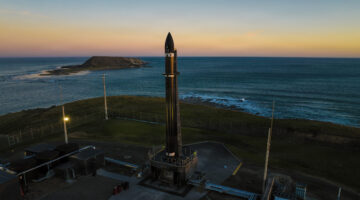
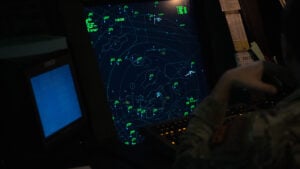
Space Force awards 3 firms $615M to track airborne targets
The task orders come under an ID/IQ with an undisclosed value granted to nine firms in April, and follow a first order to SpaceX in May worth $4.6 billion.
The SpaceX task order is the first to be awarded since the Space Force's July 17 massive $11.4 billion plus-up to the NSSL Phase 3 Lane 1 contract vehicle ceiling.
“We really used to be considered icing on the cake,” US Chief of Space Operations Gen. Chance Saltzman told reporters. Now, “I think we are more the eggs in the cake batter.”
"While this OTA agreement establishes initial SB-AMTI capability, the Space Force anticipates issuing multiple awards in the coming year ," the service said today.
The head of the NRO's commercial programs, Pete Muend, suggested that spysat agency could vet the ability of commercial satellite firms to track airborne targets for the US Space Force.
An Air Force spokesperson told Breaking Defense following the hearing that there are seven E-11s in the current fleet, and confirmed that the plan is to replace them with the emerging DAF (Department of the Air Force) Battle Network.
The Space Force did not disclose when the contracts were awarded or their individual dollar values.
Awards will be issued “fairly shortly” for the first operational satellites that can track aircraft and from space, according to Air Force Secretary Troy Meink.
Missile warning and tracking programs, and the emerging Space Data Network being developed to ferry space sensor data to shooters on the ground, in the air and at sea are among the programs seeing huge increases.
Gen. Chance Saltzman, Space Force chief, said the work already done to design a satellite system for tracking ground targets should also help speed AMTI capabilities to orbit.
Separately, Air Force Secretary Troy Meink said the Air Force will continue work on two rapid prototypes for the E-7 Wedgetail, though he did not appear to fully commit to the program.
"So the focus is going to be on delivering AMTI [airborne moving target indication] capability very quickly," Air Force Secretary Troy Meink said.
"I would say that we are at the point now where the technology has matured and it's commoditized, so that radar based AMTI from space is feasible," outgoing SDA Director Derek Tournear told Breaking Defense in an exclusive interview.
Grant Georgulis in this op-ed lays out why the E-7 program should not be cancelled, but rather developed alongside space-based AMTI.